
In Short:
- ATEX compliance is not just a technical requirement — it’s a legal obligation.
- Non-compliant equipment can expose your organisation to civil liability, regulatory sanctions, and operational shutdowns.
- Proper certification and documentation are your best protection — both on the work floor and in court.
ATEX is a legal framework, not just a technical one
Many companies treat ATEX as an operational checklist. Something for the engineers to sort out. But that’s only half the picture.
ATEX is a binding legal framework. Under Directive 2014/34/EU (ATEX 114), any company operating in potentially explosive atmospheres is legally required to use equipment that meets the relevant Ex certification standards. Without the correct CE marking and Ex code, a device cannot legally be put into service within the European Economic Area.
And it doesn’t stop there. Directive 1999/92/EC (ATEX 153) places additional obligations on employers. You must assess explosion risks, define ATEX zones, and maintain an up-to-date Explosion Protection Document (EPD). You’re also responsible for training staff and ensuring the right equipment is in use at all times.
If an inspection or incident reveals any of these elements are missing, the consequences can be serious.
What are the legal risks?
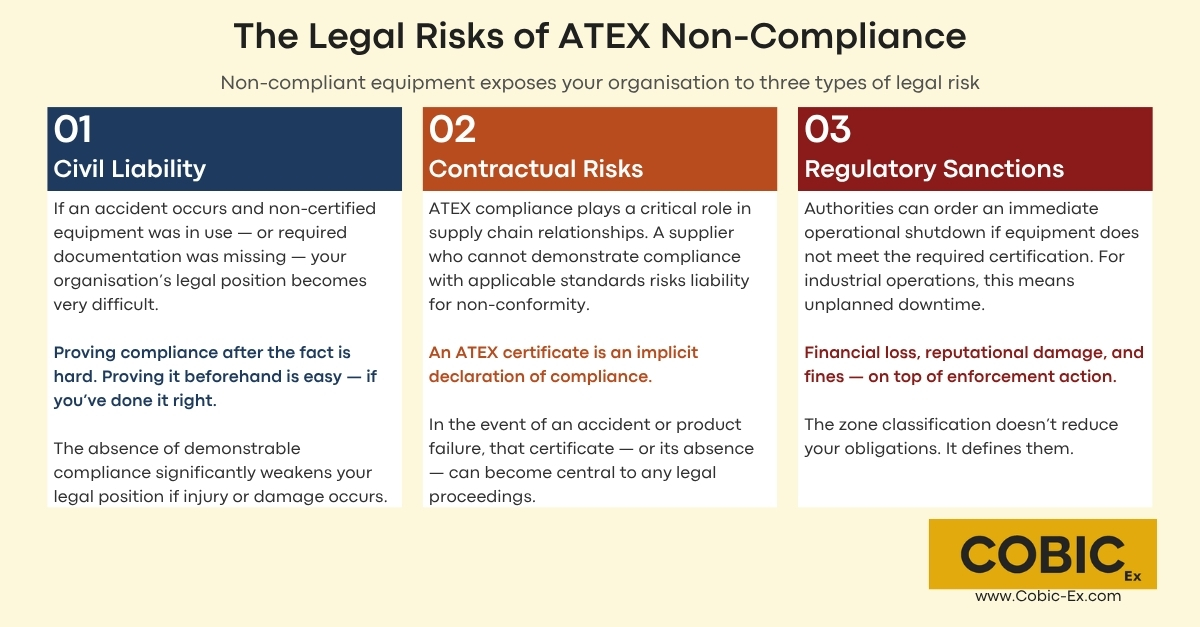
Non-compliance with ATEX regulations can lead to three main types of consequences:
- Civil liability. If an accident occurs and it turns out that non-certified equipment was in use — or that required documentation was missing — your organisation’s legal position becomes very difficult. Proving compliance after the fact is hard. Proving it beforehand is easy, if you’ve done it right.
- Contractual risks. ATEX compliance plays a role in supply chain relationships too. A supplier who cannot demonstrate that their products meet the applicable ATEX standards risks liability for non-conformity. An ATEX certificate is an implicit declaration that a product meets the directive. In the event of an accident or product failure, that certificate — or its absence — can become central to the legal proceedings.
- Regulatory sanctions and shutdowns. Authorities can order an immediate operational shutdown if equipment does not meet the required certification. For industrial operations, that means downtime, financial loss, and reputational damage — on top of any fines or legal action.
Zone 2: rare explosions, but full compliance still required
A common misconception is that Zone 2 environments — where explosive atmospheres only occur rarely and briefly — require less rigorous compliance. That’s not the case.
Zone 2 requires ATEX Category 3 equipment, with a recognised explosion protection method such as ‘Ex ec’ or ‘Ex ic’. Using a device without the correct classification or missing documentation isn’t just a safety issue. It’s a legal risk. If injury or damage occurs, the absence of demonstrable compliance significantly weakens your legal position.
The zone classification doesn’t reduce your obligations. It defines them.

Making compliance visible in practice
One practical example: visual inspections in hazardous areas. Many inspection workflows involve digital cameras or tablets. Every device used in an ATEX zone must be demonstrably certified for that zone.
This is exactly where certified equipment makes a difference — not just operationally, but legally. Using a properly certified ATEX device creates a paper trail. It shows regulators, clients, and courts that you took compliance seriously. It’s documented proof that the right equipment was in use.
That kind of documentation doesn’t just protect your employees. It protects your organisation.
ATEX compliance is increasingly a legal matter
With growing attention to risk management, ESG reporting, and supply chain accountability, ATEX compliance is increasingly landing on the desks of legal and compliance teams — not just HSE departments.
The message is simple: explosion safety is not a purely technical topic. It’s an integral part of legal risk management. And the cost of getting it wrong — financially, legally, and in human terms — is always higher than the cost of getting it right.

BONUS: Fake Ex Equipment
Not all ATEX-certified equipment is what it claims to be. Counterfeit Ex products are a real problem — and using them doesn’t just put your compliance at risk. It puts lives at risk.
Here’s what to check before you buy or install any Ex equipment:
- Check the label. Every compliant device must show the manufacturer’s name, a CE mark with a 4-digit Notified Body number, the Ex hexagon symbol, and a valid ATEX certificate number. Missing information, smudged printing, or tampered labels are immediate red flags.
- Verify the documentation. Always ask for the Declaration of Conformity and the EU Type Examination Certificate. Check that the Notified Body listed on the certificate actually exists — you can verify this on the NANDO database (EU) or UKMCAB (UK). For IECEx dual-certified products, cross-check on the IECEx database.
- Look at the build quality. Counterfeit products often give themselves away physically — poor finishes, inconsistent fasteners, loose labels, or non-certified components. If it looks off, it probably is.
- Be careful where you buy. Prices far below market average, unknown sellers, missing documentation, or an unverifiable Notified Body number are all warning signs. Legitimate suppliers are transparent and provide full traceability.
If something doesn’t add up — stop, and verify before installation. Still unsure? Just ask us.
At COBIC-Ex, we only supply the highest quality Ex-equipment, manufactured by the trusted A-brands.
In every box, we supply you with a certification pouch with the relevant certification, ensuring that your organization is compliant at all times.
Have questions about ATEX certification or choosing the right compliant equipment? We’re happy to help. Reach out at sales@cobic-ex.com
About the Author: Jules Pleijsier


